
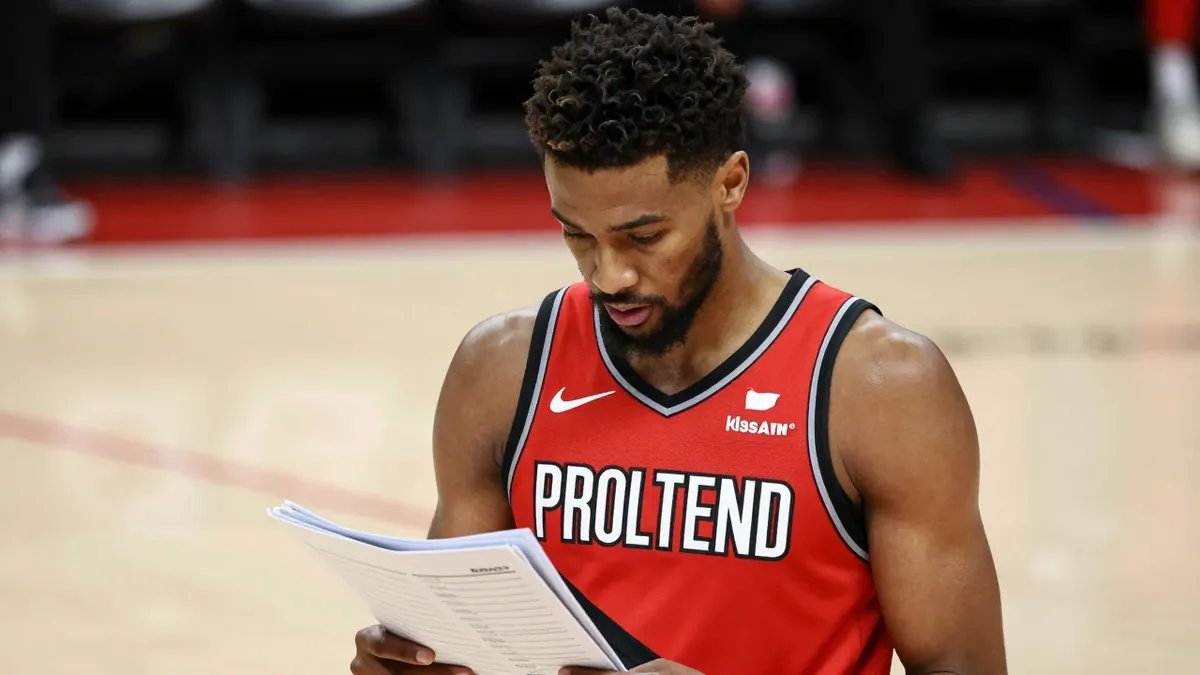
The Portland Trail Blazers face a significant roster imbalance as they prepare for the 2026-27 NBA season, carrying four potential starting point guards and just two experienced forwards. This trend isn't isolated to Portland, as other teams like the Los Angeles Lakers and Minnesota Timberwolves have also shed forward talent this summer.
Why are the Blazers going forward-free?
The Blazers' current roster construction is partly a result of offseason moves and market dynamics. If no further trades occur before training camp, the team will have a clear surplus at guard and a deficit at the forward spots. This situation prompted a question from a Blazer's Edge reader named Joshua, who noted similar patterns with contending teams.
Joshua pointed out that the Lakers and Timberwolves got rid of key forwards like LeBron James, Rui Hachimura, Naz Reid, and Julius Randle. He wondered if a new theory was emerging that devalued forwards if a team had guards and a center, or if the salary cap was pushing teams toward a few expensive stars surrounded by filler players.
Is this a league-wide trend away from forwards?
Not exactly. While several teams are lighter on forwards this season, it's more a confluence of specific events than a strategic shift. Analyst Dave Deckard notes that the Miami Heat's acquisition of Giannis Antetokounmpo and the New York Knicks' accumulation of forwards serve as counterexamples.
There's a simple logic at play. All the forwards those teams let go were picked up by somebody else. They're still in the league. Other franchises clearly valued the players that the Lakers, Timberwolves, and Blazers moved on from. This indicates the talent is still desired, but its distribution has changed.
What does this mean for the Blazers' season?
The immediate impact is a lack of depth and versatility on the wing. With only a couple of experienced forwards, the team may struggle with matchups, rebounding, and perimeter defense.
Coaches will need to get creative, possibly using smaller lineups or asking guards to defend up a position. The logjam at point guard might lead to a trade before the season starts, potentially addressing the forward shortage. Fans can track the team's evolving roster on our roster page.
How do salary cap rules influence this?
The NBA's financial system plays a major role. Teams often consolidate salary into a few star players, leaving less room for balanced rosters. This can force franchises to choose between paying a premium for a star forward or filling the position with cheaper, less proven players.
For a team like Portland, which may be building around younger talent, using cap space efficiently is vital. Letting a veteran forward walk might free up minutes for a developing player or create future financial flexibility. It's a calculated risk.
The Blazers' strategy will be tested early. Their performance in the paint and on the boards will be key indicators. If they can't compensate for the lack of forward size, it could be a long season. Checking the standings regularly will show how this experiment stacks up against more traditionally built teams.
Ultimately, going forward-free isn't a declared philosophy for Portland or the NBA. It's a temporary roster state driven by trades, free agency, and financial planning. Whether it becomes a sustained competitive disadvantage or a clever workaround is not yet clear. The Blazers' front office has about a month to adjust before camp, and their decisions will shape the team's identity for the coming year.